Will Climategate Freeze Up Cool Roofing Sales?

May 25th, 2010

In case you haven’t seen it in the news recently, another conspiracy and cover-up has been discovered and is being referred to as “Climategate.” It seems there has been some manipulation of the database of historical temperature data that has been used to support the concept of global warming. A string of emails between scientists has been uncovered that indicates there has been some manipulation and/or deletion of data that did not support global warming theories, bringing into question the validity of graphs and studies that suggest the earth is warming because of human activities.

So what does this have to do with cool roofing? Can cool roofing really influence global climate? Energy Secretary Steven Chu thinks so. Some studies have shown that cool roofing can indeed help reduce urban heat islands. This may be true, but given the recent buzz noted above, is the data in those studies also suspect?

There may be some influence on urban heat islands from cool roofs, but the real and practical proven influence cool roofing has is on energy usage. Science isn’t even necessary to prove to building owners that cool roofing reduces air conditioning needs. All that a building owner needs to do is open his or her July utility bill.

Savings in summer electricity use for air conditioning is real, and even if there is some heating penalty (the idea that white roofs will prevent a building from warming up in winter), that penalty is almost always less than the benefits from reduced cooling loads.

Share:
  • Digg
  • del.icio.us
  • Facebook
  • Google Bookmarks
  • StumbleUpon
  • Technorati
  • Twitter
  • Yahoo! Bookmarks

Fall Hazard Control: Part 2 Elimination

May 17th, 2010

In our introductory post about this topic we discussed how fall hazard control – and corresponding cost control – is increasingly being considered in constructability analyses. “Constructability” is a project management technique that reviews a building project from start to finish, during the pre-construction phase.

We also introduced the three types of fall hazard control: elimination, prevention, and protection. We will discuss prevention and protection in subsequent posts.

Elimination is the first and most effective line of defense against falls from heights. It essentially means that potential hazards should be designed out of facilities while “on the drawing board” – that is, during a constructability analysis.

As the chart indicates, the ability to influence cost is at its highest during the conceptual planning and design phases of the project.

Effective use of fall hazard elimination techniques relies heavily upon the knowledge and experience gained from past projects as well as accessing insights from operations and maintenance staff, designers, construction personnel, and the workers themselves.

When properly planned, large-size projects have the greatest potential to eliminate substantial elevated (such as rooftop) work hazard exposures.

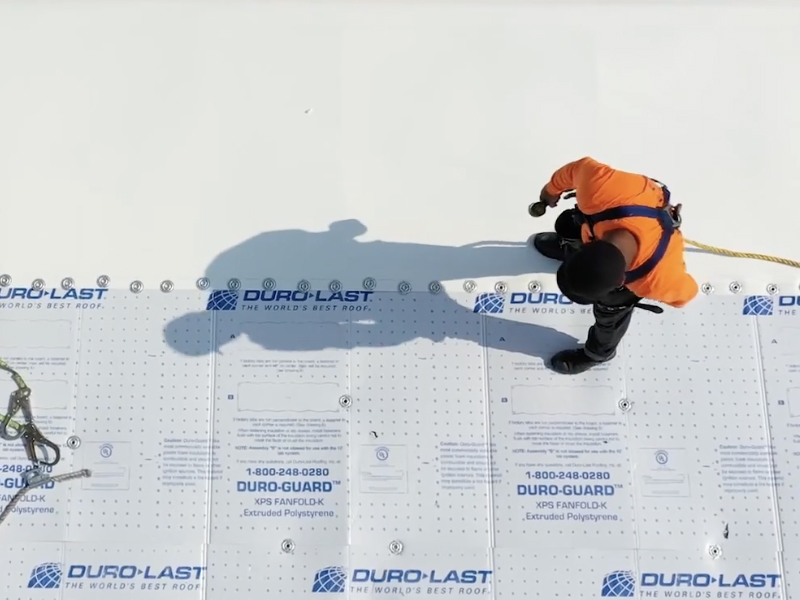
The type of roofing system selected for a building – whether new construction or retrofit – can also help in this regard. An easily-installed, pre-manufactured roofing system reduces the number of installer hours on the rooftop, “eliminating” exposure hours. Other methods include remote control or automated installation.

A roofing system that requires minimal maintenance over its life cycle also eliminates rooftop worker exposure hours.

Share:
  • Digg
  • del.icio.us
  • Facebook
  • Google Bookmarks
  • StumbleUpon
  • Technorati
  • Twitter
  • Yahoo! Bookmarks

Largest Duro-Last Installation in Canada

May 12th, 2010

For many commercial roofing systems, the challenges of Ontario’s winters mean “wait until spring” for installation, because they cannot effectively be installed in sub-freezing temperatures or during weeks of lake-effect snow storms.

This situation was confronting Olympia Tile & Stone, a Toronto-based manufacturer and distributor of ceramic, porcelain, and natural stone tiles.

Olympia’s main office and flagship showroom facility was covered with an aging and deteriorating roofing system, and leaks had begun to occur, disrupting business operations.

Olympia needed an immediate fix. A built-up roof (BUR) was on the building, and initially, the company wanted to replace it with another BUR.

Guycan Aluminum, Ltd. was the roofing contractor called in to do the job. As project plans moved forward, it became clear that a winter installation would be necessary. According to Guycan Marketing and Sales Manager Sean Claveria, “with a built-up system, we would have needed to postpone the project until spring when the snow and ice melts. Olympia Tile could not afford to wait because the current roof wouldn’t withstand another winter season. Leaks were already causing damage to their product inventory.”

Guycan and Olympia began to consider alternatives, and the single-ply Duro-Last roofing system was discussed. Guycan is an authorized Duro-Last contractor.

Alber Crimi, Olympia’s Facility manager, had heard about Duro-Last from a former colleague. “After his recommendation, we started comparing the cost of the Duro-Last system with the built-up option,” said Crimi. “Once we included the value of Duro-Last’s 15-year warranty and the fact that our maintenance problems would be gone, it became an easy choice.”

Guycan began the project in November of 2008 and despite challenging weather conditions, including cold temperatures, high winds and record snowfall; Guycan was able to install the new 50-mil Duro-Last roofing system in 28 working days.

“The Duro-Last membrane stayed flexible and easy to work with throughout the whole installation process,” said Claveria. “And because the system was manufactured in Duro-Last’s factory to fit the roof, we were able to install the Olympia project relatively quickly.”

The job was completed in February 2009 and, at 12,000 square meters (130,000 square feet), is the largest Duro-Last installation in Canada.

Winter weather in Ontario clearly presents many roofing challenges, but “we’re able to overcome them with the Duro-Last system,” concluded Claveria. “It’s a great year-round solution for our customers.”

Before

During

During Installation

Completed Project

Share:
  • Digg
  • del.icio.us
  • Facebook
  • Google Bookmarks
  • StumbleUpon
  • Technorati
  • Twitter
  • Yahoo! Bookmarks

Duro-Last® Roofing, Inc. Honored with Oregon Governor’s Sustainability Award

May 4th, 2010

Duro-Last® Roofing, Inc’s., Grants Pass, Oregon facility was honored on April 22, 2010 at the Future Energy Conference for the company’s commitment to sustainable business practices. Duro-Last was one of seven Oregon companies and non-profit organizations that were chosen as leaders in sustainability in the state.

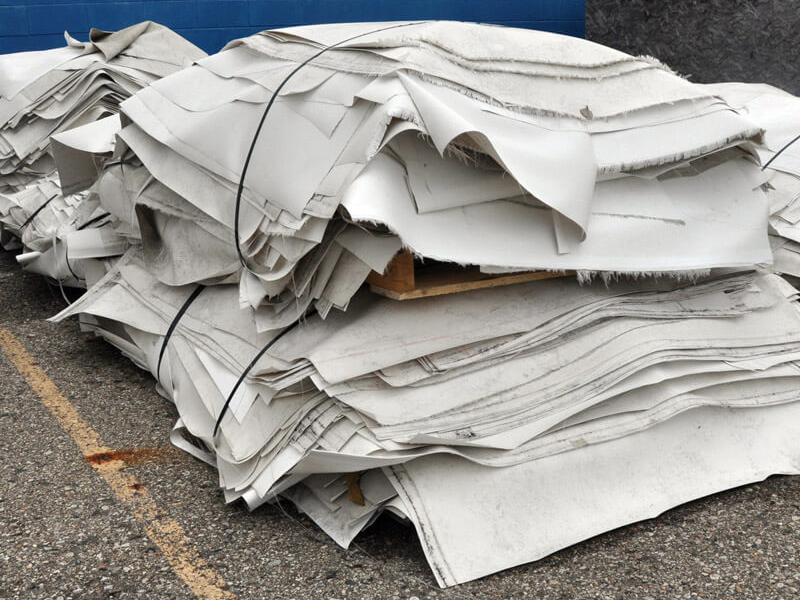
“We are honored to be recognized by a state that has very high sustainability standards,” said Tim Hart, Vice President of West Coast Operations for Duro-Last. “Our roofing system is highly reflective, which translates to energy savings for our building owner customers. We’re also proud to have a recycling program in place. We recycle 100% of the scrap we generate during production. Plus, we take back our roofs – some installed more than 20 years ago – and we also accept vinyl material from other businesses in Southern Oregon.”

Vinyl collected in Grants Pass is shipped back to Duro-Last headquarters in Saginaw, Michigan, where a subsidiary re-processes it into commercial flooring systems, expansion joints and other products.

“To date we have installed 40 million square feet of energy-efficient, recyclable roofs in the state of Oregon,” Hart concluded.

“Today we can see how the private sector and public sector alike understand that sustainability means jobs, a cleaner environment and stronger communities. These efforts generate enthusiasm for sustainability in ways that help us bridge Oregon’s urban-rural divide”, Secretary of State and Sustainability Board Chair Kate Brown said.

Tim Hart (right) accepting award from Oregon State Treasurer Ted Wheeler on behalf of Duro-Last.

Share:
  • Digg
  • del.icio.us
  • Facebook
  • Google Bookmarks
  • StumbleUpon
  • Technorati
  • Twitter
  • Yahoo! Bookmarks

Made to Move: Single ply roofing systems provide strong defense against leaks

April 26th, 2010

By Dana Howell

Damschroder Roofing LLC

This article is reprinted with permission from Properties Magazine.

Does your building have a flat roof that has been a constant problem? Do you find yourself making what seems to be never ending repairs to your flat roof? Are you convinced that there is no flat roof out there that doesn’t leak? Do you find yourself asking the question why would anyone construct a building with a flat roof? All these questions/concerns are legitimate flat roof questions.

Let’s start at the beginning. Why would you build a structure with a flat roof? There are actually many reasons, but the main reason is space. A flat roof supported by columns gives you a much larger floor plan, typically seen in banquet halls, strip malls and warehouses.

Now we understand one reason these structures are built, but what causes them to be a constant problem keeping them from leaking? Again, there are many factors, but at this time I would like to focus on just one: movement. Any time you have temperatures that fluctuate as they do in the Midwest, you will experience movement. With this being said, if your flat roof is not able to withstand movement you experience failure. This is why splitting and cracking can often be seen.

A great solution to this problem was the invention of single ply roofing. Single ply roofs are roofs that protect a building through one layer of roofing membrane as opposed to the old multi-layers of tar felt and gravel. Two popular types of single ply roofing in our region include rubber (EPDM) and roofing materials containing plastic compounds such as PVC’s (Poly Vinyl Chloride). These membranes are able to move more freely to take on the expansion and contraction often seen in large buildings.

The trend in flat roofing is clearly moving toward the single ply roofing systems over the multiple ply. Single ply roofing has been on the increase for many years while multiple ply roofs have been seeing a significant decrease in the market shard of flat roofing.

Rubber was the dominant single ply during the 1960s through the mid 1980s. Rubber is installed several different ways. Some are installed by overlapping the sheets of rubber and covering them with river rock called ballast. Others are glued or screwed to the deck. The seams are then glued together with the hope of providing a long lasting water proofing solution. The major problem associated with rubber roofs is de-lamination. De-lamination is the breaking down of the glue or adhesive that holds the sheets of rubber together.

Heat welded roofs are made of plastic compounds such as PVC. Heat welded roofing systems are the fastest growing portion of the single ply roofing industry. The welding together of PVC sheets at the seams provides a permanent and stronger bond than glues or tapes. The Duro-last Corporation in Saginaw, Michigan actually pre-welds sheets of membrane up to 2,500 square feet in their factory, thus most of the seams of a deck sheet are welded under ideal conditions.

For more information, call Damschroder Roofing LLC at 888-307-2785 or visit www.damschroderroofing.com.

Share:
  • Digg
  • del.icio.us
  • Facebook
  • Google Bookmarks
  • StumbleUpon
  • Technorati
  • Twitter
  • Yahoo! Bookmarks

How to Find a Reputable Roofing Contractor

April 19th, 2010

The answer may not be as hard as you think. Here are a few possibilities to consider:

  1. Check the telephone directory’s yellow pages. Browse the “roofing” section for the names of local people you can call for an estimate. Sometimes the ads will have specific information about the person, such as location, hours of operation, whether they accept credit card payments, and whether they provide free estimates. Call two or three contractors, so you can have a better chance to hire the right contractor for the job.
  2. Contact the Better Business Bureau. While this organization will not provide a list of names for you to call, it can give you an indication of someone’s response to complaints so that you get an idea of his or her character and reputation.
  3. Contact local roofer-related organizations. There may be roofer or construction groups in your area that can tell you what to look for in a roofing contractor, and perhaps recommend a few names.
  4. Ask building supply stores. Often they keep a list of roofers they recommend to pass along to people who are looking for consulting or hands-on help with building projects.
  5. Building companies and roofing contractors increasingly have a web presence. A good contractor web site will have photos of projects they’ve done as well as testimonials from satisfied customers.
  6. Ask for referrals. Wherever you get the name of a possible roofer for your project, follow up by contacting his references. You may even want to take a glance at the contractor’s workmanship on previous projects, if the building owner will allow access to the roof.
  7. Pay in portions. Never pay in full for a roofing job before completion of the project. You can pay a portion if you really want to, but agree to this with the contractor up front.

According to the National Roofing Contractors Association most rooftop problems are caused by installation workmanship, not material failure. Your roofing system is certainly the most critical part of your building when it comes to watertight protection, and you should make sure to hire a contractor who can be trusted to install the system correctly and stand behind their work.

Share:
  • Digg
  • del.icio.us
  • Facebook
  • Google Bookmarks
  • StumbleUpon
  • Technorati
  • Twitter
  • Yahoo! Bookmarks

Fall Hazard Control: Part 1

April 13th, 2010

The construction industry has historically addressed safety concerns primarily as a behavioral issue, with each stage of a project determining the specific hazards that might be encountered during that stage. For example, the construction phase of a facilities life cycle would typically have different workers and hazards than the operations phase, etc. As facility owners become more aware of the soaring cost of workplace injuries and are held more accountable for all phases of a project life cycle, enlightened organizations are acknowledging that certain hazards are indeed present throughout all phases of a project or facilities life cycle.

“Constructability” is a project management technique that reviews a project’s processes from start to finish, during the pre-construction phase. As the chart shows, the cumulative value of constructability (the curved line) increases over time, particularly during the latter stages of a building’s O&M phase and renovation phase.

Fall hazard control is increasingly recognized as uniquely able to prevent significant potential injury cost. When implemented and planned into the design of facilities as part of a constructability analysis, it will spread its value across all phases of a building’s life cycle.

A core concept in the use of constructability to address fall hazard control is an understanding of the hierarchy of preference of controls. This refers to the overall value and effectiveness of the three types of fall hazard control: elimination, prevention, and protection from the effects of a fall.
Here are a couple of examples of how fall hazard control might be included in a constructability analysis:

  • The installation of strategically-placed fixed anchorage points (that can be used for both fall prevention and fall protection) can reduce costs throughout ALL phases of a building’s life cycle.
  • Properly designed parapet walls (minimally 39 inches in height and enclosing the entire rooftop) is ultimately the most effective way of reducing potential fall hazards by enabling fall prevention for all future work or equipment repairs and additions.

Over the course of the next three posts we will discuss each of the three types of fall hazard control; here is a brief overview:

Elimination

This is the first and most effective line of defense against falls from heights. To do it requires a careful assessment of the workplace and the work itself. The “who, what, when, where, why, how, and how much” of each exposure is considered. This pre-consideration of the work and site often not only leads to eliminating the hazard altogether but also identifies alternative approaches to the work that can measurably enhance productivity.

Prevention

The second line of defense and often the most realistic when fall hazards cannot be entirely eliminated, is prevention. This also requires assessment of the workplace and work process. It involves making changes to the workplace so as to preclude the need to rely on the worker’s behavior and personal protection equipment to prevent falls.

Protection

Protection from the effects of a fall is the last line of defense. It should be considered only after determining that the fall hazard cannot be eliminated or the possibility of falling prevented. This is the domain of fall protection and calls for equipment such as safety nets or harnesses, lanyards, shock absorbers, fall arresters, lifelines, and anchorage connectors.

Share:
  • Digg
  • del.icio.us
  • Facebook
  • Google Bookmarks
  • StumbleUpon
  • Technorati
  • Twitter
  • Yahoo! Bookmarks

A Sighting of Bigfoot

April 7th, 2010

Recently, I have received questions about carbon content and carbon footprints associated with roofing. Before we can track down the source of those footprints we need to know what we’re searching for.

The technical definition of a carbon footprint is that it is a measure of the amount of carbon dioxide produced by a person, company, business or country over a given time. A more generic definition is that it is a measure of the impact human activities have on the environment based on the greenhouse gases produced. This second definition includes more than just carbon dioxide produced.

A primary carbon footprint considers the most direct impacts, like the use of a car or airplane. A secondary carbon footprint looks more at the entire lifecycle of activities or processes, such as with the production of a product. There are lots of theories as to how and what to measure to determine an individual carbon footprint. Numerous calculators attempt to put a numerical value to a product’s or process’ carbon footprint, but there is no single agreed-upon standard. The concept of “cap and trade” is even being debated as a means to controlling carbon footprints.

The cap and trade issue deals with controls placed on total carbon dioxide emissions. Contrary to what many people think, cap and trade is not a policy for regulating Wall Street or providing health care. A Rasmussen poll found that 76% of Americans have no clue what cap and trade means. Yet, the system, if implemented, is essentially a tax that could have broad implications for the costs of generating electricity or producing goods and services. With this scheme, carbon emissions are limited or capped and an organization is allocated an allowance for the amount it can emit. Then, companies buy and sell capacity based on whether they are emitting more or less than their quota. This could have the effect of shifting power plants from using coal, an abundant resource in the U.S., to natural gas to generate electricity.

Natural gas is the main fossil fuel source for producing ethylene used in making the vinyl chloride monomer (VCM). VCM is a key component in polyvinyl chloride (PVC or vinyl). Increases in natural gas demand will increase its price and increase costs to producers of vinyl products, including roofing and other construction components.

This is a very complex interconnected issue that is being hotly debated. There will no doubt continue to be many changes to environmental regulations in the near future. Construction specifiers are anticipating these changes and are beginning to include them in their design considerations. Construction and facility management professionals should stay informed to be able to respond appropriately.

Share:
  • Digg
  • del.icio.us
  • Facebook
  • Google Bookmarks
  • StumbleUpon
  • Technorati
  • Twitter
  • Yahoo! Bookmarks

Cool Roofing Tax Incentives

March 22nd, 2010

Two main Federal tax incentives exist for installation of cool roofing, but as with any Federal government program there are qualifications that need to be met.

Residential Tax Credit

At this time, single-ply membranes are not eligible for a tax credit on residential applications. However, if additional insulation is installed during roof replacement, the cost of the insulation can be claimed as a credit.

Commercial Tax Deduction

In general, tax law allows a deduction for part or all of the cost of energy efficient building property that the taxpayer places in service between December 31, 2005 and December 31, 2013. Several conditions must be met to qualify for the commercial tax deduction:

1. The building must be within the U.S. and must meet the requirements of ASHRAE Standard 90.1-2001 – Energy Standard for Buildings Except Low-Rise Residential Buildings.

2. To qualify for the maximum total combined deduction for all lighting, HVAC, hot water, and building envelope property installed, the total annual energy and power costs of the building must be reduced by at least 50 percent.  A partial deduction is allowed for each separate building system. The IRS set the following target reductions in March 2008:

  • Interior lighting – 20%
  • HVAC and hot water – 20%
  • Building envelope – 10%

Cool roofing is partially qualifying if it is estimated to reduce the total annual energy and power costs by 10 percent or more. The maximum deduction amount for partially qualifying property is $0.60 per square foot of the building.

3. The Performance Rating Method (PRM) must be used to compute the percentage reduction. Calculations are based on a reference building located in the same climate zone as the taxpayer’s building and containing the new building component that has been incorporated, but is otherwise identical to the reference building. The Department of Energy maintains a list of qualified software to be used to calculate energy and power costs for certification.

4. To claim the deduction, the taxpayer must obtain a certification provided by a qualified individual. The taxpayer is not required to attach the certification to the tax return, but the taxpayer must maintain proper records to establish the entitlement. A qualified individual:

  • is not related to the taxpayer claiming the deduction;
  • is an engineer or contractor that is properly licensed as a professional engineer or contractor in the jurisdiction in which the building is located; and
  • Has represented in writing to the taxpayer that he or she has the requisite qualifications.

A certification must contain:

  • the name, address, and telephone number of the qualified individual;
  • the address of the building to which the certification applies;
  • one of five statements (as outlined by the IRS) explaining the manner in which the building envelope property satisfies energy efficiency requirements.
Share:
  • Digg
  • del.icio.us
  • Facebook
  • Google Bookmarks
  • StumbleUpon
  • Technorati
  • Twitter
  • Yahoo! Bookmarks

Frequently Asked Questions about PVC Roofing Systems: Part 7

March 18th, 2010

This is the final posting in a seven part series.

Q:        I’ve heard that PVC cannot be recycled. Is this true?

A:        No. In fact, PVC is inherently recyclable. Vinyl materials can be reprocessed and recycled repeatedly, and PVC is the only roofing material that has proven to be recyclable back into new roofing products. In Europe, PVC roofing materials have been recycled for nearly 15 years. In the U.S., more than one billion pounds of post-industrial vinyl are recycled annually, and that number is growing. Many U.S. PVC roofing manufacturers have established recycling programs, including Duro-Last Roofing, Inc.’s sister company, Oscoda Plastics, Inc. has recycled an annual average of almost six million pounds of vinyl over the last three years using PVC scrap from at least 20 sources representing at least 10 types of products, including film, sheeting, seats, air domes, automotive and, of course, roofing.

The Vinyl Roofing Division of CFFA initiated a feasibility study for national recycling in January of 2008. PVC can also be safely incinerated to recover and use the latent energy, or land-filled. In fact, many landfills use PVC liners to contain contamination.

Q:        Didn’t the U.S. Green Building Council (USGBC) just propose a new LEED system for health-care facilities that awards sustainability points for avoiding halogenated products like PVC?

A:        Yes. Last November, the USGBC issued a draft proposal for LEED for Healthcare (LEED-HC) that would award points for avoiding all halogenated materials, including PVC. To date, LEED-HC has undergone two public comment periods, ending February 19, 2008 with many  organizations and member companies questioning a rating system that ignores the conclusion of their own five-year study on PVC building materials. What’s curious about the LEED-HC proposal is that it was issued just a few months after its own Technical and Scientific Advisory Committee (TSAC) issued its final report to the USGBC’s LEED Steering Committee (LSC) on the technical and scientific  basis for PVC-related credits within the LEED Green Building Rating System. Like so many other exhaustive LCA studies, the five-year TSAC study is the best environmental option.

Q:        Where can I go for more information about the safety, sustainability, use and performance of PVC roofing systems, or PVC in general?

A:        There are plenty of places to get solid, scientifically-proven information about PVC products and roofing materials:

The Vinyl Institute

Vinyl Roofing Division of CFFA

The Vinyl Environmental Council (Japan)

Vinyl In Design

Phthalate Information Center

ASTM International

The Cool Roof Rating Council (CRRC)

Duro-Last Roofing, Inc.

ENERGY STAR ratings

ENERGY STAR Roof Products energy savings calculator

Green Globes, Environmental Assessments for Buildings

Lawrence Berkeley National Laboratory

Single Ply Roofing Industry Association (SPRI)

U.S. Green Building Council, LEED Program

Share:
  • Digg
  • del.icio.us
  • Facebook
  • Google Bookmarks
  • StumbleUpon
  • Technorati
  • Twitter
  • Yahoo! Bookmarks