Archive for the ‘Roofing Industry News’ Category

Western Roofing Expo 2010

Tuesday, July 6th, 2010

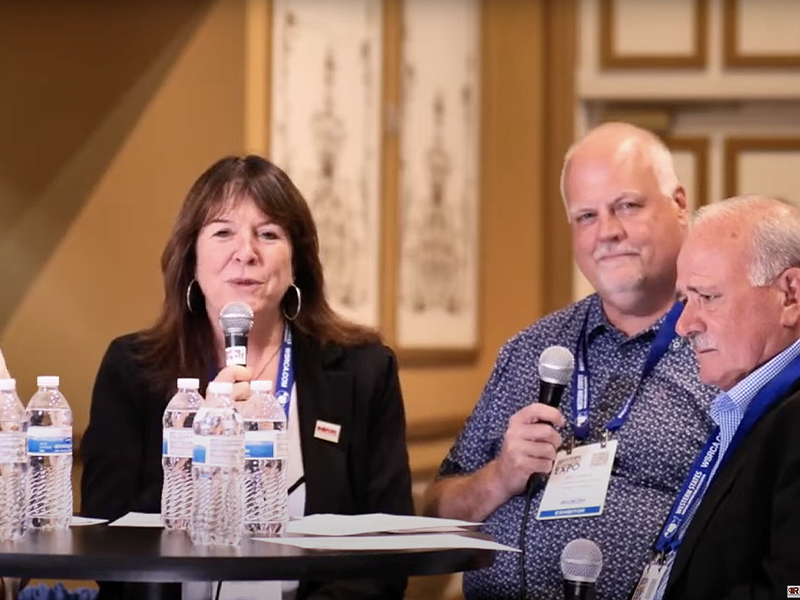
The 36th annual Western Roofing Expo was held at the Paris-Las Vegas Hotel & Casino from June 20th – June 23rd. The trade show had good attendance and the Duro-Last booth was manned by Tim Hart, Vice President of West Coast Operations, Marty Krolikowski, Rocky Mountain Regional Sales Manager, Alan Mullins, Rocky Mountain Sales Coordinator, Scott Franklin, Duro-Last Sales Representative for Los Angeles, and me. It was good to see all of the Duro-Last contractors and Independent Sales Representatives who attended.

With over 150 exhibitors and almost 3,000 attendees, the show is a great way to catch up with many of our existing contractors and see what our competitors are promoting. One topic of discussion on the show floor was the acquisition of Bradco Supply Corp. by ABC Supply Co. Inc. Although this does not affect Duro-Last directly, it is always good to know what is going on the building and construction industry.

Attendees were optimistic of the year to come and we heard a lot about roofing activity in the works. This is good news to everyone that has been affected by the economic downturn. Another buzz on the show floor was about solar. This continues to be a growing trend in commercial buildings and we were able to discuss the fact that our roofing system is Solar-Ready™ and ideal for any commercial rooftop solar application.

In addition to staffing the booth, the Duro-Last crew attended several informational sessions that were offered before the show room floors opened. One in particular was given by Mark Guy from Building Envelope Technology & Research, and Rick Olsen from Tile Roofing Institute, tiled; How the 2009 IBC Affects You and the Roofing Industry. This provided an overview of the roofing-related changes to the 2006 edition of the International Building Code, International Plumbing Code, and International Residential Code.

Next year’s expo will be at the Peppermill Resort & Casino in Reno, Nevada.

If you have any photos or stories you would like to share about your experiences at the Western Roofing Expo please post them here.

Will Climategate Freeze Up Cool Roofing Sales?

Tuesday, May 25th, 2010

In case you haven’t seen it in the news recently, another conspiracy and cover-up has been discovered and is being referred to as “Climategate.” It seems there has been some manipulation of the database of historical temperature data that has been used to support the concept of global warming. A string of emails between scientists has been uncovered that indicates there has been some manipulation and/or deletion of data that did not support global warming theories, bringing into question the validity of graphs and studies that suggest the earth is warming because of human activities.

So what does this have to do with cool roofing? Can cool roofing really influence global climate? Energy Secretary Steven Chu thinks so. Some studies have shown that cool roofing can indeed help reduce urban heat islands. This may be true, but given the recent buzz noted above, is the data in those studies also suspect?

There may be some influence on urban heat islands from cool roofs, but the real and practical proven influence cool roofing has is on energy usage. Science isn’t even necessary to prove to building owners that cool roofing reduces air conditioning needs. All that a building owner needs to do is open his or her July utility bill.

Savings in summer electricity use for air conditioning is real, and even if there is some heating penalty (the idea that white roofs will prevent a building from warming up in winter), that penalty is almost always less than the benefits from reduced cooling loads.

Made to Move: Single ply roofing systems provide strong defense against leaks

Monday, April 26th, 2010

By Dana Howell

Damschroder Roofing LLC

This article is reprinted with permission from Properties Magazine.

Does your building have a flat roof that has been a constant problem? Do you find yourself making what seems to be never ending repairs to your flat roof? Are you convinced that there is no flat roof out there that doesn’t leak? Do you find yourself asking the question why would anyone construct a building with a flat roof? All these questions/concerns are legitimate flat roof questions.

Let’s start at the beginning. Why would you build a structure with a flat roof? There are actually many reasons, but the main reason is space. A flat roof supported by columns gives you a much larger floor plan, typically seen in banquet halls, strip malls and warehouses.

Now we understand one reason these structures are built, but what causes them to be a constant problem keeping them from leaking? Again, there are many factors, but at this time I would like to focus on just one: movement. Any time you have temperatures that fluctuate as they do in the Midwest, you will experience movement. With this being said, if your flat roof is not able to withstand movement you experience failure. This is why splitting and cracking can often be seen.

A great solution to this problem was the invention of single ply roofing. Single ply roofs are roofs that protect a building through one layer of roofing membrane as opposed to the old multi-layers of tar felt and gravel. Two popular types of single ply roofing in our region include rubber (EPDM) and roofing materials containing plastic compounds such as PVC’s (Poly Vinyl Chloride). These membranes are able to move more freely to take on the expansion and contraction often seen in large buildings.

The trend in flat roofing is clearly moving toward the single ply roofing systems over the multiple ply. Single ply roofing has been on the increase for many years while multiple ply roofs have been seeing a significant decrease in the market shard of flat roofing.

Rubber was the dominant single ply during the 1960s through the mid 1980s. Rubber is installed several different ways. Some are installed by overlapping the sheets of rubber and covering them with river rock called ballast. Others are glued or screwed to the deck. The seams are then glued together with the hope of providing a long lasting water proofing solution. The major problem associated with rubber roofs is de-lamination. De-lamination is the breaking down of the glue or adhesive that holds the sheets of rubber together.

Heat welded roofs are made of plastic compounds such as PVC. Heat welded roofing systems are the fastest growing portion of the single ply roofing industry. The welding together of PVC sheets at the seams provides a permanent and stronger bond than glues or tapes. The Duro-last Corporation in Saginaw, Michigan actually pre-welds sheets of membrane up to 2,500 square feet in their factory, thus most of the seams of a deck sheet are welded under ideal conditions.

For more information, call Damschroder Roofing LLC at 888-307-2785 or visit www.damschroderroofing.com.

How to Find a Reputable Roofing Contractor

Monday, April 19th, 2010

The answer may not be as hard as you think. Here are a few possibilities to consider:

  1. Check the telephone directory’s yellow pages. Browse the “roofing” section for the names of local people you can call for an estimate. Sometimes the ads will have specific information about the person, such as location, hours of operation, whether they accept credit card payments, and whether they provide free estimates. Call two or three contractors, so you can have a better chance to hire the right contractor for the job.
  2. Contact the Better Business Bureau. While this organization will not provide a list of names for you to call, it can give you an indication of someone’s response to complaints so that you get an idea of his or her character and reputation.
  3. Contact local roofer-related organizations. There may be roofer or construction groups in your area that can tell you what to look for in a roofing contractor, and perhaps recommend a few names.
  4. Ask building supply stores. Often they keep a list of roofers they recommend to pass along to people who are looking for consulting or hands-on help with building projects.
  5. Building companies and roofing contractors increasingly have a web presence. A good contractor web site will have photos of projects they’ve done as well as testimonials from satisfied customers.
  6. Ask for referrals. Wherever you get the name of a possible roofer for your project, follow up by contacting his references. You may even want to take a glance at the contractor’s workmanship on previous projects, if the building owner will allow access to the roof.
  7. Pay in portions. Never pay in full for a roofing job before completion of the project. You can pay a portion if you really want to, but agree to this with the contractor up front.

According to the National Roofing Contractors Association most rooftop problems are caused by installation workmanship, not material failure. Your roofing system is certainly the most critical part of your building when it comes to watertight protection, and you should make sure to hire a contractor who can be trusted to install the system correctly and stand behind their work.

Cool Roofing Tax Incentives

Monday, March 22nd, 2010

Two main Federal tax incentives exist for installation of cool roofing, but as with any Federal government program there are qualifications that need to be met.

Residential Tax Credit

At this time, single-ply membranes are not eligible for a tax credit on residential applications. However, if additional insulation is installed during roof replacement, the cost of the insulation can be claimed as a credit.

Commercial Tax Deduction

In general, tax law allows a deduction for part or all of the cost of energy efficient building property that the taxpayer places in service between December 31, 2005 and December 31, 2013. Several conditions must be met to qualify for the commercial tax deduction:

1. The building must be within the U.S. and must meet the requirements of ASHRAE Standard 90.1-2001 – Energy Standard for Buildings Except Low-Rise Residential Buildings.

2. To qualify for the maximum total combined deduction for all lighting, HVAC, hot water, and building envelope property installed, the total annual energy and power costs of the building must be reduced by at least 50 percent.  A partial deduction is allowed for each separate building system. The IRS set the following target reductions in March 2008:

  • Interior lighting – 20%
  • HVAC and hot water – 20%
  • Building envelope – 10%

Cool roofing is partially qualifying if it is estimated to reduce the total annual energy and power costs by 10 percent or more. The maximum deduction amount for partially qualifying property is $0.60 per square foot of the building.

3. The Performance Rating Method (PRM) must be used to compute the percentage reduction. Calculations are based on a reference building located in the same climate zone as the taxpayer’s building and containing the new building component that has been incorporated, but is otherwise identical to the reference building. The Department of Energy maintains a list of qualified software to be used to calculate energy and power costs for certification.

4. To claim the deduction, the taxpayer must obtain a certification provided by a qualified individual. The taxpayer is not required to attach the certification to the tax return, but the taxpayer must maintain proper records to establish the entitlement. A qualified individual:

  • is not related to the taxpayer claiming the deduction;
  • is an engineer or contractor that is properly licensed as a professional engineer or contractor in the jurisdiction in which the building is located; and
  • Has represented in writing to the taxpayer that he or she has the requisite qualifications.

A certification must contain:

  • the name, address, and telephone number of the qualified individual;
  • the address of the building to which the certification applies;
  • one of five statements (as outlined by the IRS) explaining the manner in which the building envelope property satisfies energy efficiency requirements.

A Few Observations from the Recently-Concluded International Roofing Expo

Monday, March 8th, 2010

It seemed like overall show traffic was down, and that exhibitors had made smaller investments in their booths than in previous years. However, traffic to the Duro-Last booth was steady, primarily because of our hands-on welding contest for visitors and the comprehensive array of accessories displayed by Duro-Last’s division EXCEPTIONAL® Metals.

About 100 people competed in the welding contest, and anyone who could weld a roof stack in less than 90 seconds was awarded a Duro-Last t-shirt. This was intended to demonstrate how Duro-Last’s pre-fabrication approach to producing roofing systems results in labor-savings for contractors.
Duro-Last Contractor Advisory Board President Ken Kelly presented:  Tools to Manage your Business: Let the Business Run Itself. Ken discussed practical tips and tools to help track and control business functions to better manage for success. His session was relevant for companies of all sizes.

Perhaps the most prevalent technology on display during the show was rooftop solar equipment. Several solar manufacturers and providers demonstrated their wares either on their own or in conjunction with roofing system manufacturers. At Duro-Last, we promoted a “solar-ready” approach, in that our system can accommodate virtually any rooftop solar application on the market. Clearly, solar systems will be part of roof construction and retrofit discussions for the foreseeable future.

The 2011 International Roofing Expo will be held at the Las Vegas Convention Center, February 16-18.

Would you like to share your IRE experience? Send us a comment and we may post it on the blog!

The World’s Best Roof® is ready to Rise Above the Crowd at IRE

Friday, February 19th, 2010

We are all packed and ready to go to the International Roofing Expo in New Orleans, Louisiana, February 22 – 24, 2010. Duro-Last® Roofing, Inc. will be at booth #2051 exhibiting our entire product line which includes the Cool Zone®, Duro-Shield® , Rock-Ply™ and Shingle-Ply™. Steve Ruth, Tom Hollingsworth, Al Janni, Keith Gere, Drew Ballensky, Doug Clark, Jason Tunney, and Shawn Sny will all be there to answer any roofing questions you have.

Visitors will learn how Duro-Last’s prefabrication approach makes our roofing system extremely durable, and easy to install, without disruption to daily building operations. The Duro-Last roofing system is also leak-proof, resistant to high winds, and virtually maintenance-free.

Drew Ballensky will be on hand to address issues questions regarding cool roofing systems and discuss how a Duro-Last Cool Zone roof can help with LEED ratings. The Cool Zone system is both highly reflective and highly emissive, transferring less heat into the building compared to a dark colored “non-cool roof.”

Steve Kowaleski will also be at the booth ready to showcase a variety of EXCEPTIONAL® Metals products. EXCEPTIONAL Metals, a division of Duro-Last Roofing, manufactures high-quality metal components products designed to finish any roofing project.

Are you attending IRE? Send us your comments about the show and we many post them!

Greenbuild 2009: One for the Generations

Tuesday, November 17th, 2009

The brown and dusty environs of Phoenix became lush – at least for a few days last week – as Greenbuild 2009 brought its verdant footprint to the Phoenix C.C. (that’s Convention Center). The annual sustainable construction fest attracted a reported 25,000+ visitors who strolled through two exhibit halls packed with 1800 booths festooned with asparagus and lime and shamrock – and every shade of green in between. Duro-Last was one of them, and we presented our cool roofing and broader sustainability messages.

Waiting for the exhibit hall to open on Wednesday morning, November 11, 2009.

Waiting for the exhibit hall to open on Wednesday morning, November 11, 2009.

Most of my time was spent with representatives from the multitude of media outlets that serve the construction and facilities markets. Trade shows provide selling opportunities for those folks as well, and as I buy advertising for Duro-Last, I often feel like a meatloaf sandwich at a wolf convention – there’s no escape.

My informal observation was that the green part of the construction/facilities biz is doing well – or at least showing life. Traffic was strong throughout exhibit hours, even up to when things closed down late Thursday afternoon. And clearly, many exhibitors had spent serious money on their presence – size, shape, sophistication, and staff – to attract buyers to their booths. Can an investment in attending Greenbuild – to either exhibit or be exhibited to – foretell an up tick in our corner of the economy? Many would say yes, especially given that green construction products and practices are becoming easier to cost justify.

My non-scientific study also involved a casual interview with the trash police. I managed to sneak away from the media reps on one occasion for a surreptitious saunter around the show floor and spoke to some college architecture students who were monitoring the trash receptacles. They were ensuring that garbage was separated properly (organics from non-organics, etc.) before being disposed of.

Two young ladies in architecture programs at the universities of Idaho and Southern California were tending one bin. I didn’t get their names or photos, unfortunately. I did get their perceptions of the proceedings, and a couple of comments stood out.

First, they seemed pleasantly surprised that this event had attracted people from all generations. They apparently expected that a show with a green focus would be the province of the young, and perhaps not as relevant for those who have been steeped in more traditional construction practices.

Second, they said it was fairly easy for them to discern those exhibitors and attendees who had a clear commitment to sustainability and those who were merely trying to capitalize on the “green” trend.

I don’t know if they saw a connection between the two – e.g., it’s primarily baby boomers who are just riding along on the green bandwagon. Regardless: it’s clear from the stunning growth of the Greenbuild event – not to mention the enthusiasm of the architecture students – that sustainable building practices are going to be a cornerstone of the facilities world for the foreseeable future.

Is Roofing Part of Your Energy Management Strategy? Part 5

Thursday, July 30th, 2009

Regulatory Mandates

The obvious benefits of cool roofing systems have resulted in many federal, state, and local government initiatives designed to encourage or mandate their use.

Below is brief overview of Federal Energy Management Policy and Mandates. The full overview can be found here.

National Energy Conservation Policy Act (NECPA)

Signed into law in 1978, NECPA serves as the underlying authority for Federal energy management goals and requirements. It is regularly updated and amended by subsequent laws and regulations and is the foundation of most current energy requirements.

Section 543 of NECPA required a reduction in Btu/GSF of 20 percent by 2000, life-cycle cost methods and procedures, budget treatment for energy conservation measures, incentives for Federal facility energy managers, reporting requirements, new technology demonstrations, and agency surveys of energy-saving potential.

Section 102 of EPAct 2005 re-established energy reduction requirement for Federal buildings. The requirement uses a base year of fiscal year (FY) 2003 and requires reductions of 2 percent per year in energy use per square foot, leading to a 20 percent reduction in FY 2015.

In 2007, President George Bush signed Executive Order 13423, strengthening Federal environmental, energy, and transportation management. Section 2 of the Order set more challenging goals than EPAct 2005, requiring a 3 percent reduction in energy intensity per year and leading to a 30 percent reduction in 2015 compared to the base FY of 2003.

Also in 2007, President Bush signed the Energy Security and Independence Act of 2007 (EISA). EISA adopts the energy intensity reduction goals of Executive Order 13423 beginning in FY 2008 with a 9 percent reduction and increasing to a 30 percent reduction in FY 2015.

Click the links below for more detailed information.

Energy Policy Act of 1992

Executive Order 13221

Energy Policy Act of 2005

Executive Order 13423

Energy Independence & Security Act of 2007

Cool Roofing is a Win-Win Energy Management Strategy

Most building owners don’t need regulation to recognize a good thing when they see it. Even without regulatory mandates, PVC and TPO cool roofing systems have been the fastest growing commercial systems in America since the late 1990s. Many utility companies now offer rebates for using reflective roofing systems. These rebates – which can amount to several thousand dollars on large roof installations – are offered nationwide, not just in southern climates.

Best of all, cool roofing is a rare example where there are really no cost or performance tradeoffs for selecting an energy-efficient, environmentally-friendly system. The best single-ply cool roofing systems protect buildings from the rain, sleet, and snow just as well, or better, than alternative dark-surface roofing systems, and they can also play an important part in the energy management strategies of smart building owners and managers.

A Through Z of Associations: Part 6

Tuesday, July 21st, 2009

This is the last in a series of posts discussing the various associations that benefit roofing manufacturers, contractors, and other industry professionals.

SPRI

The Single Ply Roofing Industry (SPRI) is a recognized technical and statistical authority on single-plies, representing sheet membrane and related component suppliers in the commercial roofing industry. SPRI provides a forum that enables members to collectively focus their expertise and efforts on critical industry issues. By acting as a trade organization, the group can effectively improve product quality, installation techniques, workforce training, and other issues common to the industry.

Since 1981, SPRI has been a resource for building owners, architects, engineers, specifiers, contractors, and maintenance personnel, providing information about commercial roofing components and systems.

USGBC

The U.S. Green Building Council (USGBC) is a nonprofit organization that certifies sustainable businesses, homes, hospitals, schools, and neighborhoods. USGBC is dedicated to expanding green building practices and education through its LEED® (Leadership in Energy and Environmental Design) Green Building Rating System™.

The LEED system is a voluntary, consensus-based national rating system for developing high-performance, sustainable buildings. LEED addresses all building types and emphasizes state-of-the-art strategies in five areas: sustainable site development, water savings, energy-efficiency, materials and resource selection, and indoor environmental quality.

LEED Accredited Professionals (LEED APs) have demonstrated an understanding of green building techniques, the LEED Green Building Rating System, and the certification process.

VI

Founded in 1982, the Vinyl Institute (VI) is a U.S. trade association representing the leading manufacturers of vinyl, vinyl chloride monomer, vinyl additives and modifiers, and vinyl packaging materials.

VI advocates the responsible manufacture of vinyl resins; life-cycle management of vinyl products; and the promotion of the value of vinyl to society. The VI has produced a number of publications addressing the environmental aspects of vinyl products, including roofing systems. Environmental Profile: Vinyl Roofing Membranes is available at this link.